Looking Inside the Model
Direct logit attribution projects component writes toward output logits, while attention patterns show where a head reads. Vocabulary lenses ask a different observational question: what token-level scores can we extract from an intermediate residual state?
The logit lens applies the unembedding matrix directly to intermediate layers. The tuned lens learns a correction for each layer's changing basis. Both reveal decodable information, but neither shows that the model uses it.
The Logit Lens
The unembedding matrix maps the final residual stream to vocabulary logits. The logit lens, introduced by nostalgebraist in 2020, asks a simple question: what if we applied to intermediate layers? [1]interpreting GPT: the logit lens
nostalgebraist
Blog post, 2020
At each layer , we apply the model's final readout early:
This gives vocabulary logits at every layer. Applying softmax produces a diagnostic distribution, although the model itself does not normally stop and emit from that layer.
Logit Lens: The logit lens applies the final normalization and unembedding to an intermediate residual state. Its vocabulary logits show how that state aligns with the model's output directions before later layers transform it.
Consider a concrete example. When GPT-2 Small processes the prompt "The Eiffel Tower is located in the city of ___", it predicts "Paris" with 93% probability at the final layer. But at which layer does the model first "know" it will predict Paris?
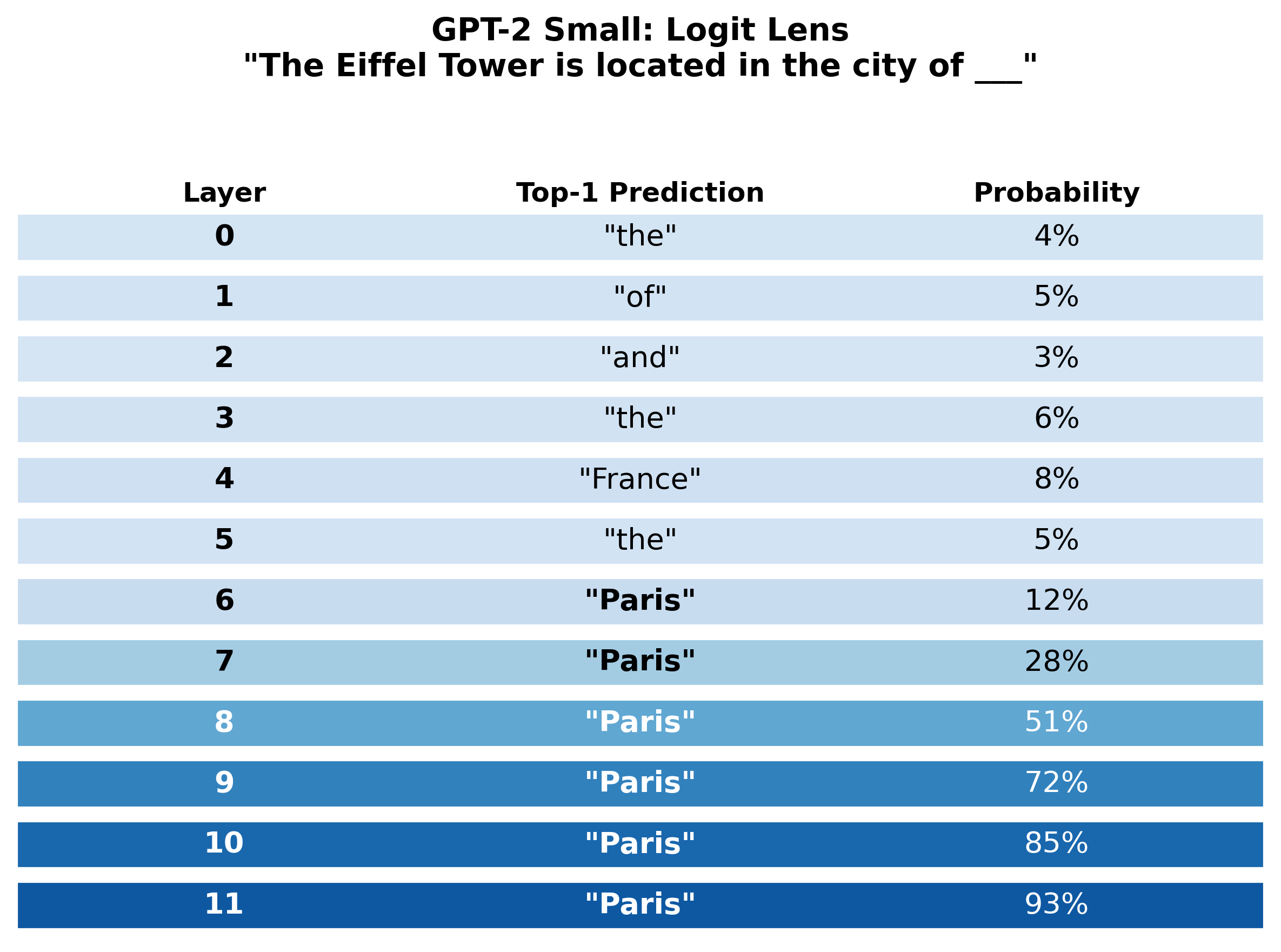
In this example, early-layer projections favor frequent generic tokens. A country-related token appears in the middle layers, and “Paris” becomes the top projected token later. This progression is a useful hypothesis about staged factual processing, but the lens alone cannot tell whether the “France” score is an intermediate variable the model uses or an incidental alignment with the unembedding.A readable sequence of tokens invites a narrative. Treat that narrative as a prediction to test with component-level and causal methods, especially because another lens or prompt may produce a different sequence.
The logit lens tells us when the answer appears, but not how the model computes it. It is a descriptive tool that shows the result of processing at each layer, revealing the trajectory without explaining the mechanism. The transition from "France" to "Paris" is interesting, but the logit lens alone cannot tell us which heads or MLPs are responsible for that transition.
Limitations of the Logit Lens
The raw logit lens can be biased toward frequent tokens and poorly calibrated at intermediate layers, with severity varying by model [2]interpreting GPT: the logit lens
nostalgebraist
Blog post, 2020. Later layers are trained to transform intermediate states before the final unembedding is applied, so an early state need not already align with output directions in a directly readable way.
A poor raw projection does not distinguish absent information from information accessible through another map. The tuned lens tests whether a learned affine translator can predict the final distribution more accurately.
The Tuned Lens
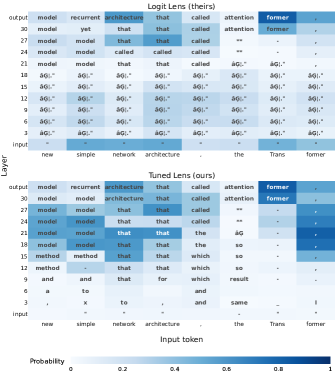
The tuned lens, introduced by Belrose et al. in 2023, trains a learned affine translator at each layer [3]Eliciting Latent Predictions from Transformers with the Tuned Lens
Belrose, N., Ostrovsky, I., McKinney, L., et al.
arXiv, 2023:
Each translator consists of a matrix and bias , trained so the translated state predicts the model's final output distribution. The affine map can compensate for systematic rotations, shifts, stretches, and other linearly correctable differences.
Tuned Lens: The tuned lens trains an affine translator at each layer to predict the final output distribution through the unembedding. It often produces better-calibrated intermediate readouts than the raw logit lens, at the cost of a learned probe.
Belrose, N., Ostrovsky, I., McKinney, L., et al.
arXiv, 2023
A critical design choice is that the translators minimize KL divergence to the final layer's output distribution, not to ground-truth labels. The lens is therefore trained to forecast the model's eventual prediction. A token score at layer 4 should not automatically be called the model's belief at layer 4; the translator may use any linearly accessible signal that helps predict the final distribution.
Comparing the lenses separates two questions: how an intermediate state aligns with the existing unembedding, and how well a learned affine probe can forecast the final output. Better tuned-lens performance shows that useful predictive signal is linearly accessible to the translator; it does not prove that later layers implement that translator or that the decoded token is an explicit intermediate variable.The tuned lens improved perplexity and calibration over the raw lens in the reported comparisons. The raw lens remains useful when the research question specifically concerns direct alignment with the unembedding or when avoiding a trained probe matters.
Pause and think: What the logit lens failure tells us
The logit lens fails on some models but the tuned lens works. What does this tell us about how models represent information across layers? Does every layer use the same coordinate system?
No single readout is guaranteed to be equally calibrated at every depth. The final unembedding is trained for the final state, while an affine translator can recover predictive structure from earlier states. This is consistent with systematic representational changes across depth, but tuned-lens success does not identify the exact transformation used by the model's later layers.
Applications of the Logit Lens Observation
The observation that layerwise projections differ has inspired decoding methods. DoLa (Decoding by Contrasting Layers) contrasts early- and late-layer logit distributions during generation [5]DoLa: Decoding by Contrasting Layers Improves Factuality in Large Language Models
Li, Y., Lin, Z., Zhang, S., et al.
ICLR 2024, 2023. It improved factuality metrics on the reported benchmarks without fine-tuning, supporting the practical value of the contrast even though the layerwise scores need not be literal beliefs.
Wendler et al. [6]Do Llamas Work in English? On the Latent Language of Multilingual Transformers
Wendler, C., Veselovsky, V., Monea, G., West, R.
ACL, 2024 found that middle-layer vocabulary projections in multilingual models often skew toward English, even for non-English inputs and outputs. This is consistent with an English-biased intermediate representation. Because the unembedding and token frequencies can also favor English, stronger claims about internal translation require controls beyond the projection itself.
Yang et al. [7]Large Language Models Internally Perform Multi-hop Factual Reasoning
Yang, J., Ding, N., Li, Y., et al.
ACL, 2024 combined vocabulary projections with activation patching to test a staged account of multi-hop factual questions. Intermediate-entity tokens appeared in middle-layer projections, and interventions supplied additional evidence about where relevant information affected the answer. The causal evidence is what turns a readable trajectory into more than a story about token scores.
The Key Limitation: Observation Cannot Establish Causation
The logit lens and tuned lens show what the model would predict if processing stopped at a given layer. They reveal the trajectory of predictions across layers. But they do not tell us which components are responsible for those predictions or whether the computation at any particular layer is necessary.
The logit lens shows "Paris" at layer 8, but is the computation at layer 8 necessary for predicting "Paris"? These observational tools establish correlations: the information co-occurs with the activations. To establish causation, we need a different kind of experiment, one where we intervene on the model's internals and observe changes in behavior.
This is the shift from observation to causation. Activation patching replaces one component's activation with an activation from a different input and measures the effect on predictions. These causal tools complete the methodological toolkit, moving us from "what exists?" to "what matters?"
Observation proposes what may be accessible; a well-designed intervention tests what changes under a specified counterfactual.