The Universality Hypothesis
In What Is Mechanistic Interpretability?, we encountered three foundational claims from Olah et al.: features are the fundamental unit of neural network computation, features connect into circuits, and analogous features and circuits form across models trained on different data. The third claim is the universality hypothesis.
If universality holds even approximately, an analysis of one model could guide work on another. Researchers could begin with a known feature or circuit instead of searching from scratch. That would not make interpretability a finite problem, models can still add, split, or repurpose features, but it would make some findings reusable.
The strength of the hypothesis depends on what “same” means. Two models might contain units with correlated activations, represent analogous functions in different bases, or implement genuinely corresponding circuits. Those claims require different evidence.Stable structure across training runs could reflect recurring structure in the data or objective, but the representation also depends on architecture, optimization, and the comparison method. Universality is therefore an empirical question at a specified level of abstraction.
Representation Similarity Metrics
Before examining the evidence for universality, we need tools to measure whether two models' representations are similar. Two metrics dominate the field: CKA and SVCCA.
CKA: Centered Kernel Alignment
Kornblith et al. (2019) introduced CKA (Centered Kernel Alignment), the most widely used metric for comparing representations across models.
The intuition: given two networks, compute the representational similarity matrix for each, how similar are pairs of inputs according to each network? Then measure the alignment between these matrices.
where HSIC is the Hilbert-Schmidt Independence Criterion, a kernel-based measure of statistical dependence between two sets of representations.
Centered Kernel Alignment (CKA): A similarity metric that measures alignment between the representational similarity structures of two networks. CKA is invariant to orthogonal transformations (if two networks learn the same representations in different coordinate systems, CKA still detects the correspondence) and invariant to isotropic scaling. CKA ranges from 0 (no alignment) to 1 (perfect alignment).
Key finding: CKA reveals that independently trained networks develop similar layer-wise structure. Early layers are more similar across networks than later layers, suggesting that lower-level features are more universal than higher-level ones.
SVCCA: An Earlier Approach
Before CKA, Raghu et al. (2017) proposed SVCCA (Singular Vector Canonical Correlation Analysis):
- Apply SVD to select the most important directions in each representation
- Use CCA (Canonical Correlation Analysis) to measure pairwise correlation between the selected directions
SVCCA found that networks converge to final representations from the bottom up, lower layers stabilize first during training. However, CKA has largely superseded SVCCA because it more reliably detects correspondences between networks trained from different initializations.Why does CKA outperform SVCCA? CKA measures the alignment of full representational structures (similarity matrices over inputs), while SVCCA measures the alignment of individual directions. Directions can differ across models even when the overall structure is preserved, making SVCCA more sensitive to superficial differences in coordinate systems.
Representation Similarity vs. Feature-Level Comparison
CKA and SVCCA answer a holistic question: "Are these representations similar overall?" Crosscoders answer a finer question: "What specific features are shared or different?"
The two approaches are complementary. CKA provides a relatively cheap, aggregate comparison; crosscoders require training but propose specific shared and model-exclusive features. Neither metric decides universality on its own: the result depends on the data, layers, alignment method, and level of abstraction being compared.
Three Dimensions of Universality
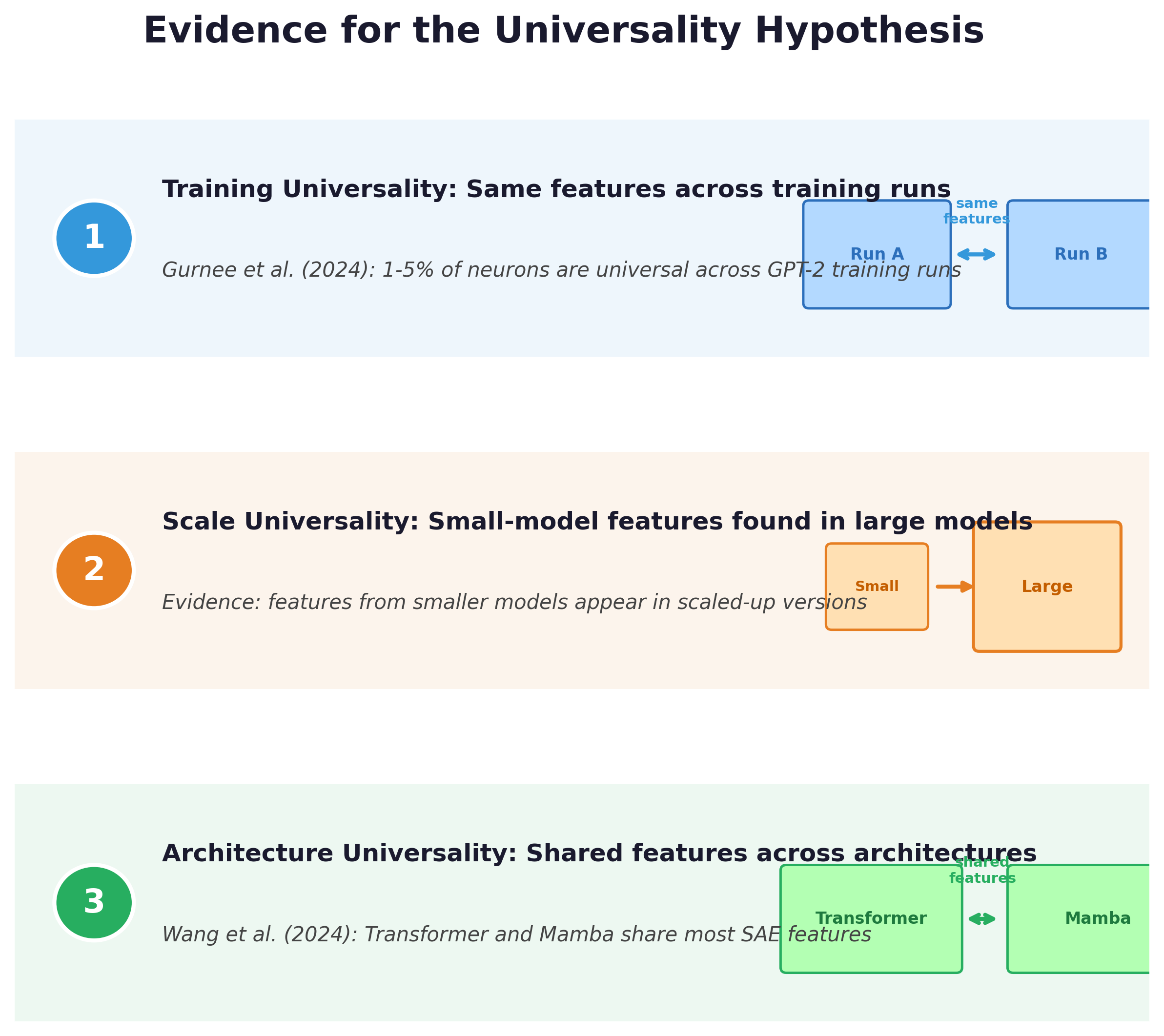
The evidence for universality comes along three dimensions: training universality (same architecture, different random seeds), scale universality (same architecture, different sizes), and architecture universality (different architectures entirely).
Training Universality
Gurnee et al. (2024) studied GPT-2 models trained from different random seeds [1]Universal Neurons in GPT2 Language Models
Gurnee, W., Horsley, T., Guo, Z. C., et al.
TMLR, 2024. The key findings:
- 1-5% of neurons are universal, they consistently activate on the same inputs across independently trained models
- Universal neurons are monosemantic and interpretable, with large weight norms and low activation frequency
- They have clear functional roles: deactivating attention heads, changing entropy of the next-token distribution, predicting token set membership
These neurons have unusually similar activation patterns across independent training runs. Calling them the same unit is stronger: it also requires a meaningful correspondence in function and downstream effect. Their relative interpretability supports the hypothesis that some stable features reflect recurring structure in the data, without implying that every matched neuron has one exhaustive semantic label.
Scale Universality
Evidence suggests that features found in smaller models also appear in larger ones:
- Features discovered by SAEs in small models (e.g., GPT-2) often have counterparts in larger models (e.g., GPT-2 XL, Llama)
- The feature vocabulary seems to grow with scale rather than change, larger models add new features on top of the existing ones
- Larger models may represent the same concepts with higher fidelity and less superposition
This is encouraging for interpretability research: understanding small models may transfer to understanding large ones, at least at the feature level. The features discovered during scaling monosemanticity in Claude 3 Sonnet included many features analogous to those found in the much smaller one-layer model studied earlier.
Pause and think: What would break universality?
If universality holds, features discovered in one model should appear in others. Under what conditions might universality break down? Consider: models trained on very different data distributions, models with very different architectures, or models trained with very different objectives. Would a vision model and a language model share features? Would a model trained on code share features with one trained on natural language?
The answer may depend on what level of abstraction you consider. At the lowest level (token patterns, syntax), features are domain-specific. At higher levels (logical structure, causal reasoning), there may be more commonality. The universality hypothesis is likely not all-or-nothing but a matter of degree that varies across feature types.
Architecture Universality
Wang et al. (2024) compared features across entirely different architectures:
- Trained SAEs on both Transformer and Mamba (a state-space model) and compared the learned features
- Most features are similar across architectures
- Induction circuits in Mamba are structurally analogous to those in Transformers, with an "off-by-one" motif difference
This is the strongest form of universality: not just the same architecture with different initializations, but fundamentally different computational primitives converging on similar features. Transformers use attention to route information; Mamba uses selective state spaces. Yet they learn comparable features for similar tasks.Architecture universality is particularly important for MI's future. If new architectures (SSMs, hybrid models, mixture-of-experts) learn similar features to Transformers, then MI tools developed for Transformers may transfer. If not, MI would need to develop architecture-specific methods for each new model family.
Weak vs. Strong Universality
Two versions of the universality claim are useful to separate:
Weak universality: Different models develop features that serve similar functions (e.g., both detect sentence boundaries), but the specific directions and implementations may differ. The features are analogous but not identical.
Strong universality: Different models develop the same features with corresponding directions that can be mapped onto each other. The features are not just functionally similar but representationally equivalent.
Current evidence is more compatible with weak universality than with a one-to-one universal feature dictionary. Strong universality is harder to establish because similarity in activation does not by itself prove identical computation. Results on matched neurons suggest that close correspondences exist for a minority of units in the models tested.
Crosscoders provide the most direct test of universality at the feature level: a crosscoder trained across two models finds shared features (evidence for universality) and exclusive features (evidence against it). CKA provides a holistic measure of representation alignment that does not require identifying individual features.
Pause and think: Universality and safety
If universality holds, MI results from one model may generalize to others. Why would that make safety analysis more scalable?
Consider a safety evaluation that discovers a dangerous internal mechanism in Model A. If universality holds, we have reason to check whether Model B has a similar mechanism, and the tools (crosscoders, CKA) to test this efficiently. If universality does not hold, every model is a blank slate requiring full analysis from scratch. With models being deployed at increasing scale and speed, the ability to transfer safety insights across models could be the difference between tractable and intractable safety evaluation.
Testing Transfer Beyond Language Models
Current evidence gives us concrete correspondences to test, not permission to assume that any interpretation transfers. Centered kernel alignment (CKA) can flag broad representational similarity, matched units can identify local candidates, and crosscoders can separate shared from model-specific features. Causal interventions must still establish whether a matched feature plays the same role in both systems.
Architecture-level transfer becomes harder when the inputs and computations change. Multimodal Mechanistic Interpretability asks which parts of the language-model toolkit survive in vision-language and diffusion models, and which modality-specific structures demand new methods.