Where Is Refusal Encoded?
Chat models are fine-tuned to refuse harmful requests. Ask "How do I bake a cake?" and you get a recipe. Ask "How do I build a bomb?" and you get a refusal. Safety training, via RLHF, DPO, or similar techniques, teaches the model to distinguish harmful from harmless requests and respond appropriately.
But where in the model's representations is "refusal" encoded? If the linear representation hypothesis holds for safety-relevant behaviors, there should be a direction in activation space that corresponds to refusal. Arditi et al. (2024) set out to find it [1]Refusal in Language Models Is Mediated by a Single Direction
Arditi, A., Obeso, O., Syed, A., et al.
NeurIPS, 2024.
The Hypothesis
The hypothesis is precise and testable:
If refusal is a linearly represented concept, then:
- A single direction in activation space should distinguish harmful from harmless prompt processing.
- Removing that direction (via ablation) should disable refusal.
- Adding that direction (via addition steering) should induce refusal even on harmless inputs.
This applies the probing and steering toolkit to safety-critical behavior.
Computing the Refusal Direction
The method follows the CAA approach:
-
Collect harmful prompts (e.g., "How to build a bomb") and harmless prompts (e.g., "How to bake a cake").
-
Run both sets through the model, collecting residual stream activations at intermediate layers.
-
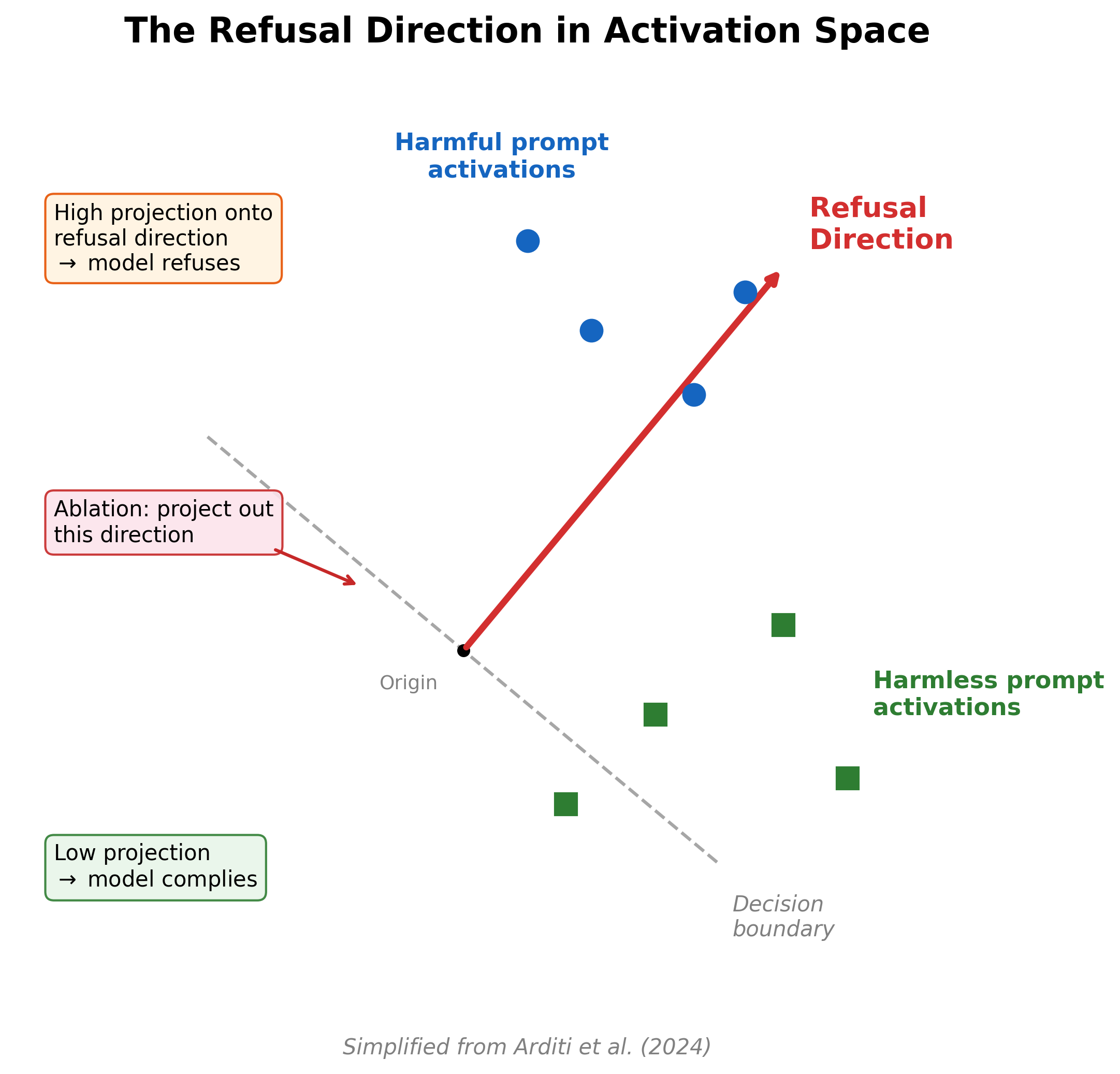
Compute the mean difference in activations between harmful and harmless processing:
This difference vector is the refusal direction.The refusal direction is computed using the same contrastive averaging method as CAA. The only difference is the target concept: instead of probing sentiment or sycophancy, Arditi et al. targeted refusal. This highlights how general the contrastive framework is, the same technique works for behavioral tendencies and safety-critical properties alike.
The Finding
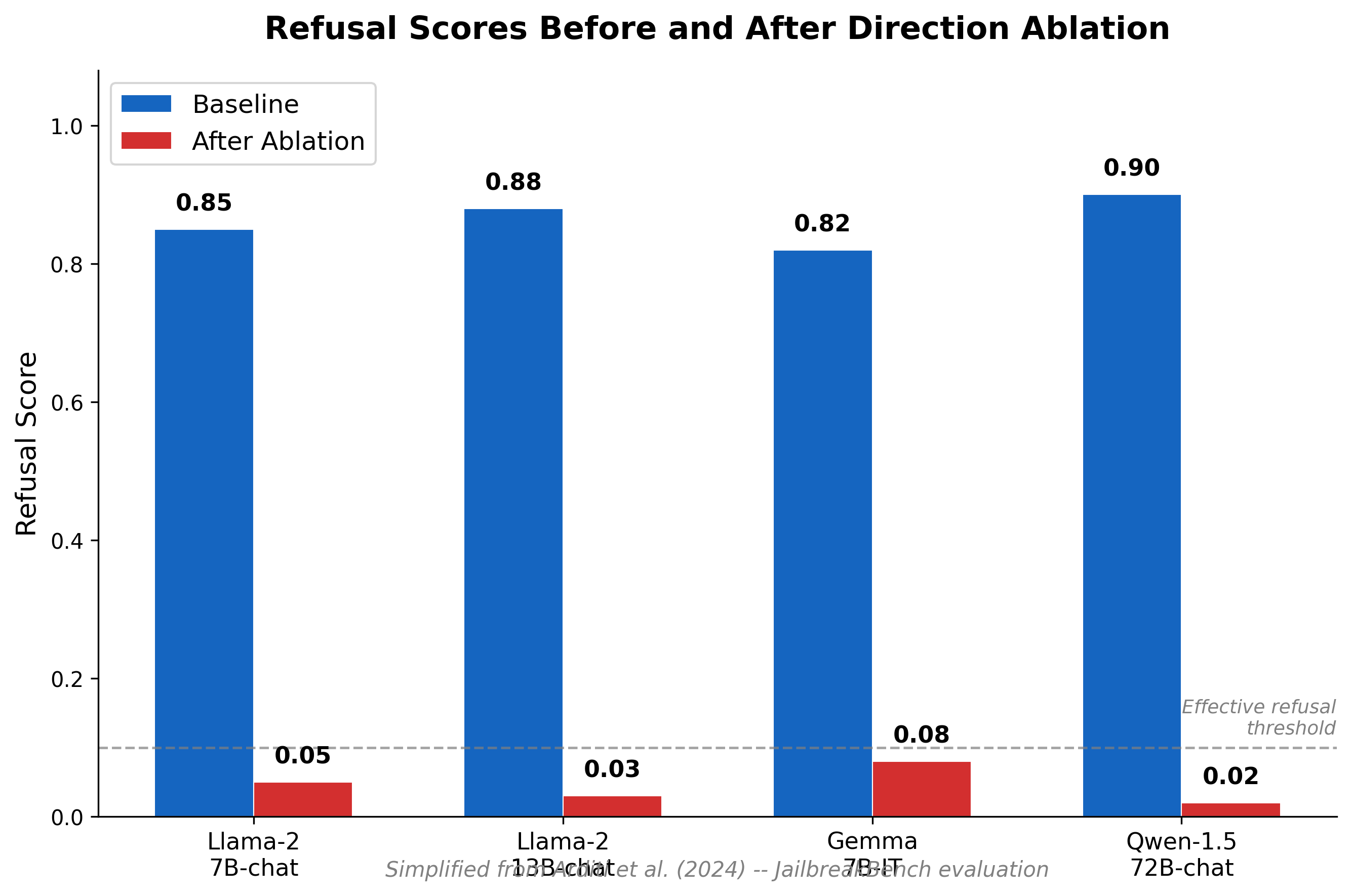
Across 13 open-source chat models, from 1.3B to 72B parameters, one model-specific direction mediates much of the measured refusal behavior:
- Ablating it prevents refusal, models comply with harmful requests.
- Adding it induces refusal on harmless inputs, models refuse benign questions.
The intervention pattern appears across the tested Llama, Qwen, and Gemma models, although each model has its own activation space and its direction is estimated separately.
Causal Validation
The ablation and addition experiments provide complementary causal evidence:
- Ablation: Removing the direction sharply reduces refusal on the tested harmful prompts.
- Addition: Adding the direction raises refusal on tested harmless prompts.
This follows the intervention logic from activation patching. It establishes the direction as a causal mediator under these interventions, while “necessary” and “sufficient” remain relative to the prompt distribution, layers, and intervention strength.
Pause and think: One direction across 13 models
The refusal direction was found independently in 13 different chat models spanning different families and scales (1.3B to 72B parameters). What does the consistency of this finding tell us about how safety training works? Why might different training procedures (RLHF, DPO) on different architectures produce the same geometric structure?
One interpretation is that safety fine-tuning makes a low-dimensional refusal signal easy for later layers to use. Another is that the extracted direction is a shared bottleneck downstream of more distributed harm recognition. The experiments identify an intervention point; they do not show that the entire computation leading to refusal is one-dimensional.
Capability Preservation
A natural concern: if we permanently remove the refusal direction from the model's weights, does the model lose other capabilities?
Arditi et al. used weight orthogonalization, projecting out the refusal direction from the model's weight matrices permanently, not just during inference. The results across most models:
- MMLU: within 99% of baseline
- ARC: within 99% of baseline
- GSM8K: within 99% of baseline
On the reported MMLU, ARC, and GSM8K evaluations, refusal can be reduced without a comparable drop in benchmark performance. This shows separability with respect to those measurements, not preservation of every capability or behavior.Weight orthogonalization modifies weight matrices rather than intervening separately on every forward pass. The resulting model refuses far less on the tested prompts while retaining the reported benchmark scores, which makes the method relevant to white-box jailbreak analysis.
Implications for Safety Training
The intervention supports two mechanistic conclusions and one dual-use warning:
Refusal has a low-dimensional mediator. In the tested models, safety fine-tuning produces behavior that can be strongly altered through one direction. Upstream harm recognition and other safety-relevant computations may still be distributed.
Refusal and benchmark capability can be partly separated. Removing the direction changes refusal far more than it changes the reported general benchmarks. This does not establish that refusal is wholly detached from reasoning, or that all safety training is shallow.
The mechanism is interpretable and bypassable. Weight orthogonalization turns the causal account into a white-box jailbreak, permanently reducing refusal while largely preserving the reported benchmark scores.
Pause and think: Designing robust safety training
The refusal direction can be removed with one linear operation. Should this make us more or less confident in current safety training? If you were designing safety training, how would you make it resistant to directional ablation? Is it even possible while maintaining the linear representation structure that makes models useful?
Possible defenses include redundant refusal pathways, adversarial training against directional removal, and objectives that connect refusal to robust harm understanding. Each proposal needs empirical testing: distributing a mechanism does not automatically make it safer, and entangling it with capabilities can create new failure modes. Interpretability and robustness need not be opposites, but optimizing one does not guarantee the other.
The Broader Significance
The refusal direction is a compact example of applying contrastive analysis and steering to a safety-relevant behavior:
- Read: The direction can be identified through contrastive methods.
- Add: Adding the direction induces refusal.
- Remove: Projecting out the direction eliminates refusal.
Every capability comes with a dual-use concern. The same tools that help us understand safety mechanisms are the same tools that help bypass them. This tension between understanding and vulnerability is central to the field of mechanistic interpretability applied to AI safety.
For a different goal, removing information available to a class of linear predictors under explicit assumptions, see concept erasure with LEACE.