From Reading to Control
Probing methods identify directions in activation space that correspond to concepts. But what happens if we add those directions during inference? Can we steer model behavior by intervening directly on the residual stream?
Addition steering modifies a model's internal activations during inference to influence its outputs [1]Steering Language Models With Activation Engineering
Turner, A. M., Thiergart, L., Leech, G., et al.
arXiv, 2024. Unlike fine-tuning, it leaves the weights fixed; unlike prompting, it intervenes after the input has entered the model. Once a direction has been estimated, the intervention itself is a vector addition during the forward pass.
Addition Steering: The inference-time modification of a model's internal activations by adding a steering vector to the residual stream. The vector is added at a chosen layer during the forward pass, shifting the model's behavior toward a target concept without modifying the model's weights.
The technique builds on a simple but powerful insight: if the residual stream is a linear communication channel, and if concepts are linear directions in activation space (as the linear representation hypothesis predicts), then adding a direction should steer the model toward that concept.
The ActAdd Method
Turner et al. (2024) introduced ActAdd (Activation Addition), the simplest version of addition steering [2]Steering Language Models With Activation Engineering
Turner, A. M., Thiergart, L., Leech, G., et al.
arXiv, 2024. The recipe has four steps:
-
Choose two contrasting prompts. For example, "Love" and "Hate." These should differ primarily in the concept you want to steer toward.
-
Run both through the model. Collect residual stream activations at a chosen layer .
-
Compute the difference. Subtract the negative activation from the positive activation. This difference is the steering vector:
- Add during generation. At each forward pass, add the steering vector to the residual stream at layer :
where controls the steering strength.The scaling factor plays a critical role. Too small, and the steering has no effect. Too large, and the model produces incoherent text. Typical values range from 1 to 15 depending on the model and concept. The sweet spot must be found empirically.
Controlling Direction and Intensity
The parameter controls both direction and intensity:
- : steer toward the positive prompt (e.g., more "Love")
- : steer toward the negative prompt (e.g., more "Hate")
- : no intervention (original model behavior)
This bidirectionality is powerful. A single steering vector enables both amplification and suppression of a concept, depending on the sign of .
Key Properties
Lightweight. No training, no optimization, no backward pass. Only forward passes to compute the steering vector, then simple addition during inference.
Data-efficient. Works with a single contrast pair, as few as 2 prompts. For more robust steering, use directions computed via CAA.
Can preserve off-target performance at moderate strengths. Published evaluations often find small changes on broad capability benchmarks, but this must be checked for each vector, layer, coefficient, and input distribution.
Natural-language interface. The steering direction is specified through text prompts, not learned parameters.
Pause and think: Why middle layers?
Addition steering is most effective at middle layers (roughly layers 15-17 in Llama 2). Why might early or late layers be less effective for steering?
In many reported experiments, early-layer interventions have weak or disruptive effects, while very late interventions leave little computation in which the change can propagate. Middle layers are therefore a useful starting point, but the best layer depends on the concept, model, token position, and metric.
Application: Inducing Behavior
Addition steering can induce behaviors that the model would not normally exhibit:
Sycophancy steering: Add the sycophancy direction (computed via CAA) and the model agrees with the user even when the user is wrong.
Sentiment steering: Add a "positive sentiment" direction and responses become more optimistic and cheerful.
Refusal induction: Add the refusal direction to harmless prompts and the model may refuse even benign questions such as “What is the capital of France?”This intervention is causal evidence: changing the activation along the chosen direction changes refusal behavior. Calling the direction sufficient is shorthand for sufficiency under the tested intervention, layers, prompts, and intact remainder of the model.
Refusal induction shows that adding the direction can cause the measured behavior in the tested setting. Ablation asks the complementary question: does projecting out the direction reduce the behavior? Together, the interventions support a causal-mediator claim without showing that the representation is unique or that no alternative pathway exists.
Additivity with Other Methods
A key finding: steering stacks additively with other methods:
- Addition steering + fine-tuning: the effects combine without interfering.
- Addition steering + few-shot prompting: prompting effects and steering effects add together.
- MMLU scores (a proxy for general capabilities) remain largely intact after steering.
This suggests that steering operates in a direction somewhat orthogonal to general capabilities. You can shift the model's behavioral tendencies without breaking its underlying competence.The additivity result has practical implications. It means steering vectors could be combined with standard alignment techniques like RLHF or DPO, providing an additional control channel that works at inference time rather than training time.
The Geometric Picture
Addition steering has a clean geometric interpretation:
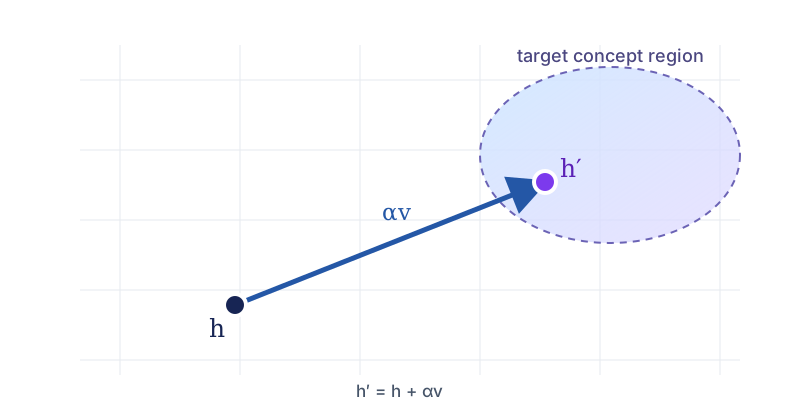
The residual stream activation is a point in high-dimensional space. Adding a steering vector translates that point along the concept direction. The translated point is closer to (or further from, depending on ) the region of activation space associated with the target concept.
Pause and think: Designing a steering experiment
Suppose you want to steer a model to be more concise in its responses. How would you design the contrast pairs? What positive and negative prompts would you use? What layer range would you try first?
For contrast pairs, ask the same questions with matched instructions such as “explain briefly” and “explain in detail.” Sweep several layers and intervention strengths on development data instead of assuming the best layer in advance. Then test held-out topics and measure not only length but also accuracy, completeness, and fluency, since the pairs may differ along those dimensions too.
Limitations
Addition steering assumes linearity: that concepts are directions and that adding those directions has consistent effects. This assumption fails for:
- Context-dependent behaviors. "Be helpful" might mean different things in different situations. A single direction cannot capture this context-dependence.
- Conditional logic. Behaviors like "be honest unless honesty would cause serious harm" are inherently non-linear.
- Interference effects. Steering strongly in one direction may have unintended effects on related concepts.
For behaviors that resist single-direction steering, more sophisticated interventions may be needed.
One option is to replace the straight-line intervention with a path that follows a learned low-dimensional surface. Manifold Steering develops this idea and tests whether staying near the model's observed activation geometry produces more natural intermediate behavior.
Connection to the Toolkit
Addition steering is one of three fundamental operations on concept directions:
- Read with LAT and CAA, detect what concepts are encoded.
- Add with addition steering, steer behavior toward a concept.
- Remove with ablation, eliminate a concept's influence.
Together, these operations form a useful framework for testing and controlling model representations. Addition and ablation probe opposite interventions, but their conclusions remain conditional on the prompts, layers, coefficients, and behavioral metric used.
Addition steering changes one forward pass at inference time. Interpretability-Guided Training reuses concept directions during fine-tuning, where an activation intervention can change what the optimizer writes into the weights.