What Can Simple Models Compute?
Before we can appreciate what composition makes possible, we need to understand what a model without composition can do. Consider the simplest possible transformer: a one-layer, attention-only model with attention heads and no MLP. The output at each position is:
Here is head 's attention matrix. Each head operates on the same initial residual stream, so no head can use another head's output from that layer. Its attention pattern can depend on token and positional information already in the stream, but not on a computation performed by an earlier attention layer [1]A Mathematical Framework for Transformer Circuits
Elhage, N., Nanda, N., Olsson, C., et al.
Anthropic, 2021.
Two end-to-end matrices summarize token-identity effects. The QK matrix gives the token-token contribution to the pre-softmax attention score. It is not itself an attention probability, because position terms, the causal mask, and competing source tokens also affect the softmax. The OV matrix gives the direct vocabulary-logit effect of moving an embedded source token through the head's OV pathway.These products are exact weight-derived terms under the simplified embedding-only analysis. They do not alone characterize a full sequence-level behavior: attention probabilities depend on the other tokens and positions, and final logits include all paths and normalization.
These matrices describe the head's token-to-token QK and OV behavior. Together with positional effects and the causal mask, they explain patterns such as bigram prediction, longer-range token copying, and attention to fixed relative positions.
One attention layer has no earlier attention output to enrich its keys or queries. It therefore cannot implement the same two-step predecessor-copying mechanism used by the induction circuit described below. This is an architectural statement about that mechanism, not a claim that no one-layer network with different components or positional features can ever approximate repeated-pattern behavior.
The Power of Two Layers
With two layers, the model gains a qualitatively new capability. The output now expands into three types of terms:
The composition terms let a layer-2 head read information written by layer 1. Through K-composition, for example, a layer-1 head can add predecessor information to the residual stream at each position, and a layer-2 head can use that information when constructing its keys.K-composition is not the only form of composition. Q-composition changes what a layer-2 head searches for, and V-composition changes what information is moved. K-composition is central to the induction mechanism described here because the earlier head supplies information used by the later head's keys.
The qualitative jump is stark. One-layer models see raw tokens and compute fixed token-to-token mappings. Two-layer models see enriched tokens, where each position carries information deposited by layer-1 heads. This enrichment is what makes context-dependent pattern matching possible.
Pause and think: What new capability emerges?
Two layers can do something one layer cannot. Given what you know about composition, can you guess what new capability emerges? Think about what information a layer-1 head could add to each position, and how a layer-2 head could use that enriched information to make predictions that depend on context rather than just token identity.
The Induction Pattern
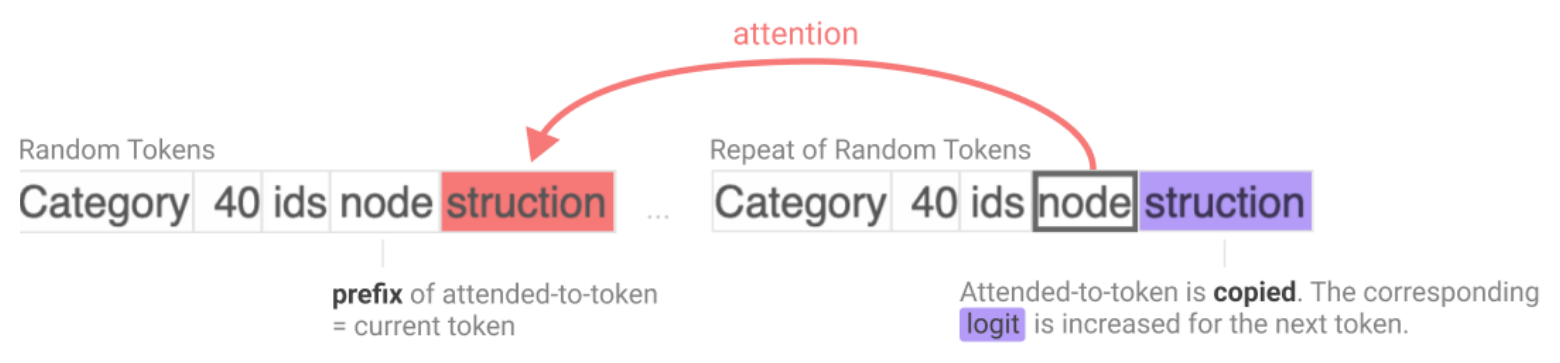
Consider a sequence where a pattern repeats:
The model sees followed by earlier in the context. When appears again, the induction score measures whether the model raises . Tests on random or held-out token pairs help show that the effect is a reusable copying pattern rather than memorization of a particular pair.
Take a concrete example. In the sequence "The cat sat on the cat ...", at the second "cat" position the model should predict "sat", the token that followed the first "cat." This requires the model to find the previous occurrence of "cat" in the context, identify that "sat" followed it, and copy "sat" to the output. No single attention head can do all three steps. This requires composition [2]In-context Learning and Induction Heads
Olsson, C., Elhage, N., Nanda, N., et al.
Anthropic, 2022.
Olsson, C., Elhage, N., Nanda, N., et al.
Anthropic, 2022
The Two-Step Mechanism
The induction head circuit uses two attention heads across two layers, working together through K-composition.
Previous Token Head: An attention head (typically in layer 1) that attends to the immediately preceding position. At position , it copies information about the token at position into the residual stream. After this head runs, each position carries not just its own token identity but also the identity of the token before it.
Step 1. The previous token head runs in layer 1. At every position, it attends to the position immediately before it (producing a characteristic diagonal stripe in the attention pattern matrix). After this head writes to the residual stream, the position holding "sat" now encodes: "I am 'sat' and the token before me was 'cat'." The position holding "on" encodes: "I am 'on' and the token before me was 'sat'." Every position in the sequence is enriched with predecessor information.
Induction Head: An attention head (typically in layer 2) that, at the second occurrence of token , attends to the token that previously followed . It implements the pattern by using predecessor information in its keys to find matching contexts.
Step 2. The induction head runs in layer 2. At the second occurrence of "cat", this head's query effectively says: "I am looking for a position whose predecessor was 'cat'." Thanks to the previous token head, the position holding "sat" has "predecessor = cat" in its key. The induction head attends to "sat" and copies its token identity to the output. The prediction is "sat."
The mechanism is K-composition in action. The layer-1 head enriches the keys with predecessor information. The layer-2 head uses those enriched keys to attend based on context, not just raw token identity.
Reading the Attention Patterns
The two heads in the induction circuit have distinctive attention patterns that are recognizable in attention heatmaps.
The previous token head produces a strong diagonal stripe shifted by one position because each destination attends heavily to its immediate predecessor. On a suitable repeated-token prompt, this position-based pattern should persist when the token identities change.A shifted diagonal is evidence for previous-position attention, not a complete functional label. The head's output–value circuit determines what it copies from that position, and the pattern should be checked across inputs.
The induction head produces an off-diagonal stripe that breaks the regular diagonal pattern. At positions where a token repeats, the head attends not to the repeated token itself, but to the token that followed the previous occurrence. In the sequence "A B C D A B", the second "A" (position 5) attends strongly to "B" (position 2), and the second "B" (position 6) attends strongly to "C" (position 3). The pattern is content-dependent: it appears only at positions with repeated tokens and points to the position after the previous match.
These shapes are useful clues, not diagnoses. A clean shifted diagonal suggests a previous-token pattern, while off-diagonal spikes after repeated contexts suggest induction. Confirm the hypothesis across varied inputs and inspect what the head writes through its OV circuit.
The Phase Change
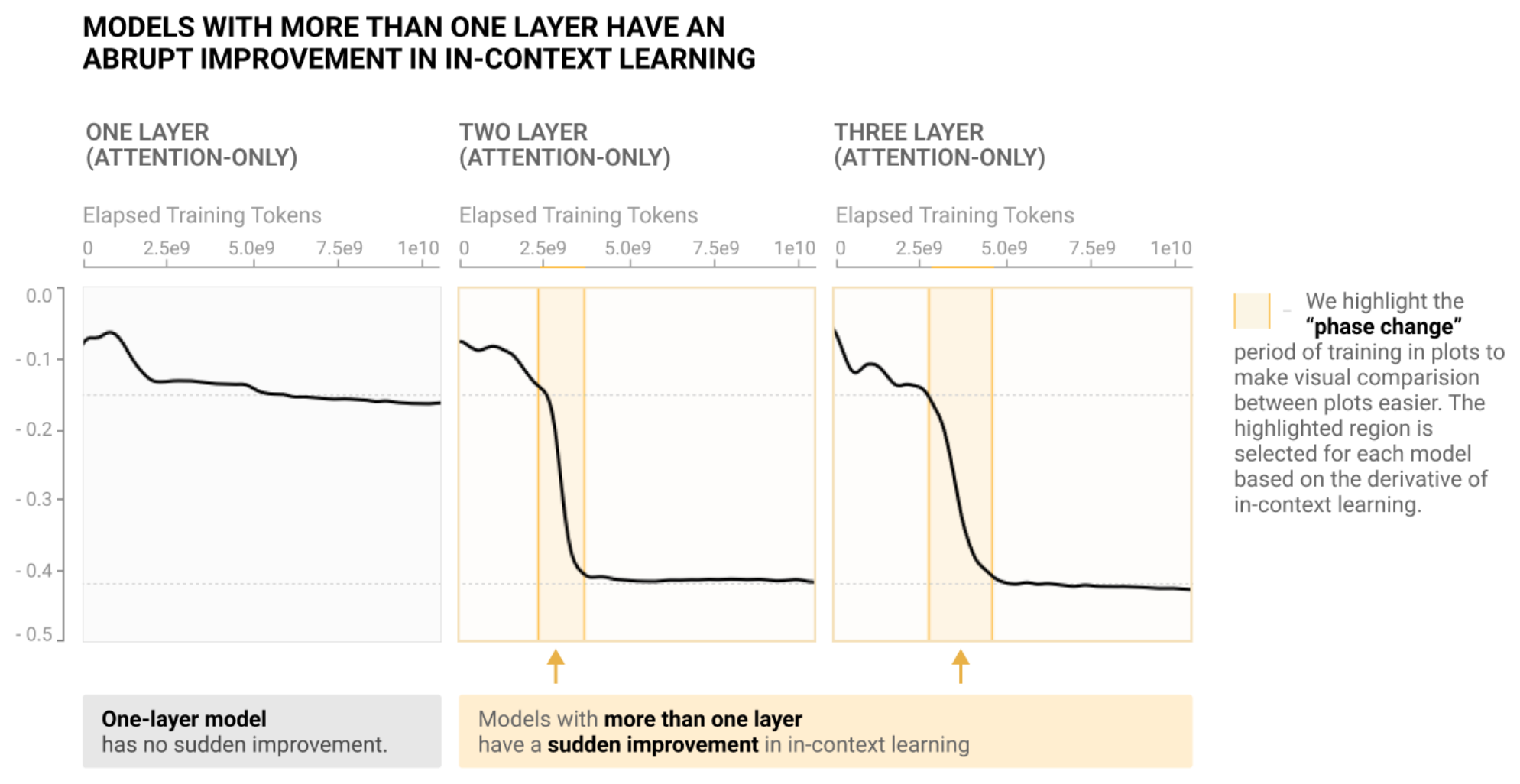
In the small attention-only models studied by Olsson et al., a particular measure of in-context learning improves sharply during training, producing a visible change in the loss curve [4]In-context Learning and Induction Heads
Olsson, C., Elhage, N., Nanda, N., et al.
Anthropic, 2022. Before this transition, extra context helps much less; afterward, the model makes better use of repeated patterns farther back in the sequence.
For these runs, the change is much sharper than a smooth learning curve would suggest. Before it, loss improves over the first part of the context and then plateaus. After it, useful context extends much farther. This is evidence for an abrupt change in the models studied, rather than a claim that every capability in every transformer emerges this way.
Olsson, C., Elhage, N., Nanda, N., et al.
Anthropic, 2022
Induction-like heads appear around the same training period as this transition, and several experiments support a causal role. In the small models tested, ablating the relevant heads substantially reduces the measured in-context-learning score. Architectural changes that restrict composition also delay or weaken the transition. Together, these results connect induction circuitry to the observed pattern-completion behavior, while leaving room for other mechanisms and other forms of in-context learning.
Pause and think: Phase changes and AI safety
The model suddenly gains a new capability at a specific point in training. What might this mean for AI safety? If capabilities can emerge abruptly rather than gradually, how does that affect our ability to predict what a model will be able to do? Consider whether other, more concerning capabilities might also emerge through sudden phase transitions.
From Toy Models to Large Models
Despite being discovered in tiny attention-only models, induction-like heads have also been observed in much larger transformers. Their behavior is often less literal there: some respond to approximate or semantic matches rather than exact repeated tokens. That makes induction a plausible ingredient in richer context use, but not a complete explanation of it.In small models, the circuit can look like literal token copying: see 'cat' again, then predict what followed 'cat' before. In larger models, researchers have found related heads with fuzzier matching behavior. Calling both cases 'induction' is useful, but the larger-model mechanism needs to be established rather than assumed from a similar-looking attention pattern.
The discovery matters because it connects a mechanism that can be derived cleanly in toy models to related behavior in larger systems. It offers a concrete test of a common mechanistic-interpretability strategy: use simple models to form precise hypotheses, then check how far those hypotheses transfer.RASP (Restricted Access Sequence Processing Language) describes computations using operations that transformers can perform, such as selecting tokens, aggregating information, and composing operations across layers {% cite "weiss2021rasp" %}. The Tracr compiler can turn a subset of these programs into transformer weights, providing a bridge between an algorithmic description and a concrete model.
Induction heads are a canonical example of composition producing behavior that one attention layer cannot implement in the same way. The mathematical framework from the composition and virtual heads article supplies the analytical tools; experiments then test whether the proposed two-step mechanism is actually present and causally relevant.
Looking Ahead
We have seen a concrete circuit: two attention heads composing across layers to implement pattern completion. The next question is how to systematically measure the contribution of each component. Direct logit attribution provides this tool, decomposing the model's output logits into per-component contributions and letting us ask precisely which heads matter most for any given prediction. Beyond attribution, the discovery of circuits like the induction head motivates the search for more complex circuits, such as the IOI circuit that handles indirect object identification through a coordinated network of more than twenty attention heads.