What Does an LLM Actually Do?
At the highest level, a language model takes text as input and outputs a probability distribution over what token comes next. Feed it "the cat sat on the" and it assigns probabilities to possible continuations: "mat" might get 15%, "floor" 12%, "bed" 8%, and so on.The model doesn't see words directly. Text first goes through a tokenizer, which we'll discuss shortly.
The architecture inside that does this computation is called a transformer [1]Attention Is All You Need
Vaswani, A., Shazeer, N., Parmar, N., et al.
NeurIPS, 2017. Despite all the improvements since the original 2017 paper, the core architecture has remained remarkably stable. The differences between GPT-2 (2019) and modern frontier models are mostly about scale: more layers, more parameters, more training data. The fundamental building blocks are the same.
Why Next-Token Prediction Might Mean Understanding
Consider GPT-2 Small: the model weights are about half a gigabyte, but it was trained on roughly 150 GB of text. The model is much smaller than its training data, yet it can reasonably predict the next token across that entire corpus. It cannot simply be memorizing all those gigabytes, since it lacks the capacity.
If you took a collection of math textbooks, erased all the proofs, and someone could fill in the blanks reasonably well, you would not say they are merely memorizing. They must have internalized something about how mathematics works.
The same logic applies here: a model that can compress a much larger dataset into reasonable predictions must have developed some internal representation of language structure, facts, and patterns. Compression, in some sense, is understanding. You may find this claim debatable, but it motivates why we might expect interesting structure inside these models.
Tokenization: Text to Numbers
Neural networks operate on numbers, not strings. Before any computation, text passes through a tokenizer, which converts it into a sequence of integers called tokens.
The tokenizer is constructed before training (using compression techniques like Byte-Pair Encoding) and remains fixed. For common English words, each word typically becomes one token. For rare words, foreign text, or gibberish, the tokenizer breaks them into smaller pieces.You can explore how different models tokenize text at tools like OpenAI's tokenizer playground. It's worth getting an intuition for how common words become single tokens while rare words fragment into multiple pieces.
For example, with GPT-2's tokenizer:
- "The quick brown fox" becomes 4 tokens (one per word, with spaces attached)
- An uncommon word like "gimble" might become two tokens: "g" and "imble"
- Keyboard mashing produces many tokens, roughly one per character pair
Two tokenization details matter for interpretability work. First, most tokenizers prepend a special beginning-of-sequence (BOS) token to every input. This token appears at position 0 in every sequence, which makes it a fixed landmark. Attention heads that have nothing useful to attend to often default to the BOS position, using it as a "rest position." This produces a characteristic vertical stripe (column pattern) in attention visualizations: many positions attending to position 0. When you see this pattern, it usually does not mean the BOS token contains meaningful information. It means those heads are effectively idle on that input.Some models (like GPT-2) do not use a dedicated BOS token but exhibit the same column-pattern behavior on whatever token happens to be at position 0. The principle is the same: a fixed, predictable position serves as a default attention target.
Second, most tokenizers are sensitive to leading whitespace. The token for " cat" (with a space prefix) is a different token from "cat" (no space). In normal text, most words appear with a preceding space, so " cat" is the common form. This distinction trips up many MI experiments: if you manually construct prompts or look up token IDs, forgetting the space prefix gives you the wrong token.
For the rest of this article, we will take tokenization as a black box and focus on what happens once we have our sequence of token IDs.
The Big Picture
A decoder-only transformer processes a sequence by repeatedly applying two sublayers at every layer:
- Attention: move information between positions.
- MLP: transform information at each position.
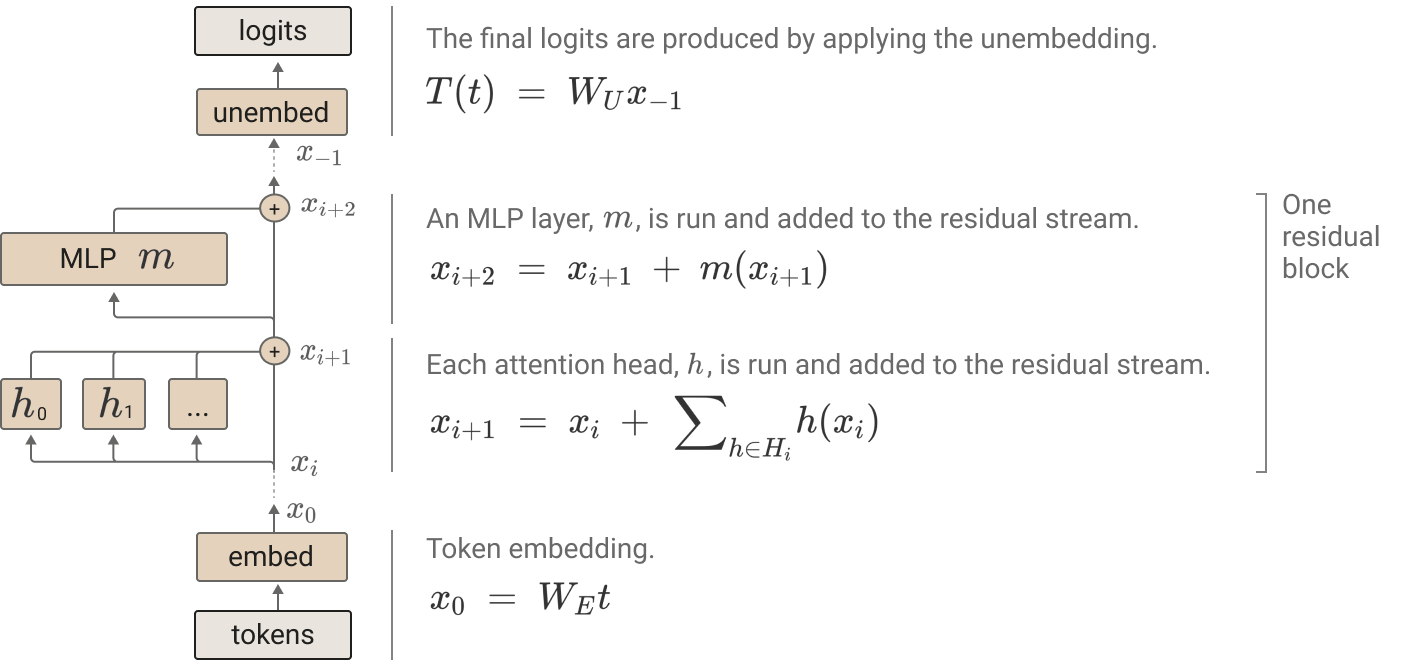
Both sublayers write their outputs into a shared residual stream, which acts like a global scratchpad.
Elhage, N., Nanda, N., Olsson, C., et al.
Anthropic, 2021
Parallel Predictions
Here is a crucial insight about how transformers process sequences: given an input of tokens, the model makes predictions simultaneously. Each position predicts what token comes next at that position, conditioned only on tokens at earlier positions.This is enforced by causal masking in the attention mechanism. Position i can only attend to positions 0 through i, never to the future.
During training, a single sequence becomes training examples. Position 0 predicts token 1 given no context. Position 1 predicts token 2 given token 0. Position predicts token given all previous tokens. The model adjusts its weights to make each of these predictions slightly better.
This parallel structure is why transformers are so efficient to train compared to earlier architectures like RNNs, which had to process tokens sequentially. RNNs compute a hidden state that depends on all previous hidden states, so computing the output at position requires sequential steps. Transformers sidestep this: attention lets every position look at every earlier position in a single parallel operation. This parallelism is a major reason transformers have become dominant.
Step 0: Tokens to Vectors
Once we have our sequence of token IDs, we need to convert them into vectors that the neural network can process. Each token becomes a vector through two lookups:
- Token Embedding: A learned lookup table maps each token ID to a high-dimensional vector. Tokens with similar meanings or usage patterns tend to end up with similar embedding vectors, though this is entirely learned from data.
- Positional Encoding (PE): Nothing in the attention mechanism inherently distinguishes position 3 from position 7. Attention computes similarity between vectors regardless of where they sit in the sequence. If we shuffled the token vectors into a different order but kept the vectors themselves identical, attention would produce the same outputs. This is what "permutation-invariant" means: the operation treats the input as a set, not a sequence. But word order matters ("the dog bit the man" vs. "the man bit the dog"), so we add a position-dependent vector to each token embedding. This can be learned embeddings (a lookup table indexed by position) or fixed sinusoidal patterns.
Step 1: Attention (Information Routing)
Attention is the mechanism that allows tokens to communicate with each other. Each position can look at all previous positions, decide which are relevant, and gather information from them.
The core idea: every token plays three roles simultaneously:
- Query: "What am I looking for?"
- Key: "What do I contain?"
- Value: "What information do I send if attended to?"
Each token's query is compared against every other token's key (via dot product) to produce attention weights. These weights determine how much each token contributes to the output. The final output is a weighted sum of value vectors.
Multi-head attention runs several attention heads in parallel, each with its own learned query/key/value projections. Different heads can attend to different things: one might look at the previous token, another at the subject of the sentence, another at tokens matching some learned pattern.
For the full mathematical details of attention, including the softmax normalization, scaling, and causal masking, see The Attention Mechanism.
Step 2: MLP (Local Computation)
After attention, each position passes through an MLP (multi-layer perceptron). Unlike attention, the MLP operates independently on each position: it does no cross-token communication.
Think of it as: attention moves information between positions, then the MLP processes that information within each position. MLPs hold roughly two-thirds of a transformer's parameters and play a central role in storing and retrieving knowledge. We cover their structure, the key-value memory interpretation, and the factual recall pipeline in MLPs in Transformers.
The Residual Stream
Residual Stream: The residual stream is the vector that flows through the transformer, updated additively by each component. Every attention head and MLP reads from it and writes to it.
The residual stream starts as the token embedding and accumulates updates from every layer:
Think of it as a shared whiteboard. Each component reads the whole whiteboard, computes something, and writes its result back. The whiteboard accumulates all contributions. No component communicates directly with any other. Attention head 3 in layer 5 has no direct wire to MLP 2 in layer 7. Instead, head 3 writes to the residual stream, and MLP 2 reads from it. This shared-bus architecture is what makes the transformer amenable to mechanistic analysis.
The additive structure is the key insight. Because the final output is a sum of contributions from every component, we can decompose it and ask: how much did attention head 3 in layer 5 contribute to predicting "cat"? This leads directly to techniques like direct logit attribution, which measures each component's contribution to the output logits, and activation patching, which tests whether a component is causally necessary. Both will be covered in later articles.
Interestingly, if you take the residual stream halfway through the model and apply the unembedding matrix directly, you do not get nonsense. You get a rough approximation of the model's final prediction. The residual stream gradually refines its representation layer by layer, and this gradual refinement is what makes interventions on intermediate layers meaningful.
Layer Normalization
Layer normalization appears before each sublayer and is essential for stable training. Without it, activations grow unboundedly across layers and gradients explode. We cover layer normalization in detail in Layer Normalization, including the pre-norm vs. post-norm distinction, RMSNorm, and why it introduces a nonlinearity that matters for mechanistic interpretability.
The Full Stack (Compact Form)
For clarity, this recurrence omits layer normalization, which is applied before each sublayer in practice. A decoder-only transformer applies this recurrence for each layer :
After layers, the final residual stream is mapped to logits: a vector of raw, unnormalized scores with one entry per token in the vocabulary. If the vocabulary has 50,000 tokens, the logits are a 50,000-dimensional vector. Each entry represents how strongly the model favors that token as the next-token prediction. Higher logit = more favored, but the values are not yet probabilities (they can be negative, and they don't sum to 1).
where is the unembedding matrix, which projects the -dimensional residual stream into vocabulary-sized scores. The logits are then passed through softmax to get a proper probability distribution over the vocabulary:
Softmax exponentiates each logit and normalizes so the values sum to 1. This amplifies differences: a token with a logit just a few points higher than its competitors can end up with most of the probability mass.
Training: Making Loss Go Down
Training a language model is conceptually simple: show the model text, have it predict the next token at every position, and adjust weights to make correct predictions more likely.
For a sequence of tokens , the model predicts a probability distribution at each position. We measure how wrong these predictions are using cross-entropy loss: the negative log probability assigned to the actual next token.
If the model assigns 50% probability to the correct next token, the loss contribution is . If it assigns 99% probability, the loss is only . Training via gradient descent tweaks all the weights (embeddings, attention parameters, MLP weights, unembedding) to make the loss a little lower.
Every part of the transformer is learned: which embedding vectors to use, what attention patterns to form, what the MLPs compute. If it makes sense for "cat" and "feline" to have similar embeddings (because they predict similar next tokens), the model will learn that from data.
Generating Text
Once trained, the model produces a probability distribution over next tokens. Choosing a token from that distribution and repeating the process produces text. The choice of decoding strategy (greedy, temperature-scaled, nucleus sampling, beam search) affects quality and diversity. We cover these in Decoding Strategies.
The generation loop feeds the full sequence back through the model at each step. The model has no memory between steps: each forward pass is independent, and the model does not know which tokens it generated versus which were in the original prompt.
Why This Matters for MI
Mechanistic interpretability treats the model as a computation graph we can open. Because the transformer's core operations are structured and mostly linear in the residual stream, we can trace, ablate, and patch individual components.
The additive residual stream means we can decompose the output into contributions from each component. The parallel structure of attention means we can study individual heads in isolation. The fact that everything is learned means the model may have discovered interpretable algorithms we can reverse-engineer.
Notation Reference
Throughout the curriculum, we use the following notation consistently:
| Symbol | Meaning |
|---|---|
| Token embedding or activation vector | |
| Weight matrix (generic) | |
| Residual stream state | |
| Query, Key, Value, Output projection matrices | |
| Query, key, value vectors (for a single token) | |
| Residual stream dimension | |
| Key/query dimension per head () | |
| Number of attention heads | |
| Output of attention at layer | |
| Output of MLP at layer | |
| Embedding and unembedding operations | |
| Layer normalization |